
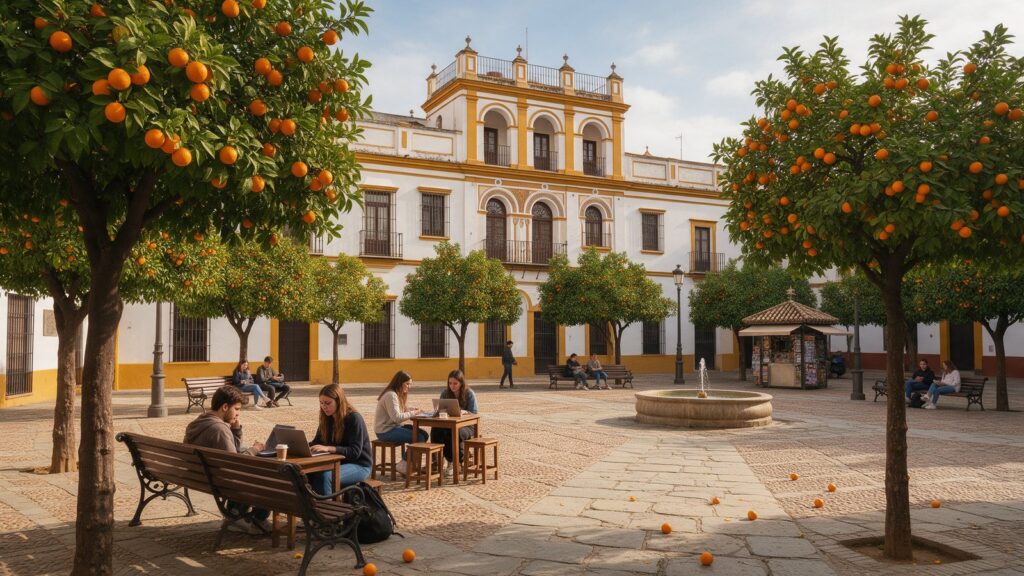
Studying in Seville means living in a city where the university is part of the landscape: the campuses sit inside the urban fabric, the river and the parks act as an extension of the library, and the calendar revolves around Semana Santa (Holy Week) and the Feria. This guide gathers what you should know before you arrive: where the campuses are, how to get around, which areas and activities you will find, how to cope with the heat and how to organise your budget. At the end we look at how to choose between university residences in Seville and what a student residence in Seville located inside the Reina Mercedes campus has to offer.
The University of Seville campuses: where they are and what you can study at each
The University of Seville (US) had around 64,000 students enrolled in the 2025-2026 academic year across bachelor’s, master’s and doctoral programmes, according to its statistical yearbook. There is no single campus far from the centre: the faculties are spread across several parts of the city, so the faculty you choose largely determines where it makes sense for you to live.
Reina Mercedes: architecture, sciences and engineering
This is the main campus for technical and scientific degrees. According to the Camplus website, the faculties and schools of Architecture, Pharmacy, Mathematics, Physics, Computer Engineering, Chemistry and Biology are located in it or very close by. It lies next to Avenida de la Palmera and near the Benito Villamarín Stadium, and the surrounding area lives to the rhythm of the classes.
Ramón y Cajal: law, economics and psychology
This campus brings together, among other centres, the faculties of Law, Economics and Business, and Psychology. Its big advantage is transport: the Faculty of Economics is a few minutes’ walk from San Bernardo station, where the Cercanías (suburban rail) and Metro line 1 meet.
Macarena and Cartuja: health, engineering and communication
The Macarena campus groups the Health Sciences degrees, such as Medicine or Nursing. On the Isla de la Cartuja you will find the School of Engineering and the Faculty of Communication. Other centres, such as Philology or Geography and History, are located around the Rectorate, right in the city centre.
UPO, Loyola and other university centres
The Pablo de Olavide University (UPO) is in the south-east of the city and has its own stop on Metro line 1, Pablo de Olavide. Loyola Andalucía University has its Seville campus in Dos Hermanas. There are also university centres such as EUSA or San Isidoro, each with its own site. To find out how long it takes to travel between campuses from Reina Mercedes, check the timetables and routes of the Seville Metro and Tussam.
Getting around Seville: Tussam, metro, Cercanías and Sevici
You do not need a car to get to class in Seville. There are four options that complement each other: city buses, the metro, Cercanías trains and public bicycles. None of them reaches every campus on its own, so the practical approach is to combine them according to your faculty.
City buses and the Tussam Student Card
Tussam, the municipal bus company, publishes a route and timetable planner on its website. If you are enrolled at a centre in Seville city you can apply for its Student Card, available as a monthly pass or for September to July, which allows unlimited travel on urban lines except special services and the airport line. In Tussam’s table of travel passes the monthly pass is listed at €19 (€11.40 with the discount in force in 2026). Prices and requirements change every academic year, so check them before applying.
The Youth Card (Tarjeta Joven), for people aged 16 to 29, also requires you to be registered as a resident in Seville city and not to exceed a family income limit, so it is not always an option when you arrive from elsewhere.
Metro and Cercanías
Seville Metro line 1 runs from the Aljarafe to Dos Hermanas and stops at Puerta de Jerez, Prado de San Sebastián, San Bernardo, Nervión, UPO (Pablo de Olavide station) and, further south, Europa and Olivar de Quintos, the stations Loyola recommends for reaching its campus. Renfe Cercanías connects stations such as Virgen del Rocío, San Bernardo and Santa Justa: the Camplus website estimates 16 minutes by train to Ramón y Cajal.
Public bikes and bike lanes
Sevici is the city council’s public bicycle service. According to the Camplus website, there is a station a few metres from its residence, on Avenida de Reina Mercedes, and the city has a bike lane that runs across it. Subscription options and their rates can be found on the Sevici website. By bike, several journeys between campuses take just 10-15 minutes.
Leisure, parties and climate: what daily life is like for a university student in Seville
Daytime plans: river, parks and day trips
A good part of student life in Seville happens outdoors. The Guadalquivir and its banks are the usual place to run, meet friends or switch off, and the Parque de María Luisa, next to Prado de San Sebastián, is a classic refuge for reading when the library gets overwhelming. Among the activities Camplus organises each year are a welcome walking tour, a boat trip on the Guadalquivir at sunset, visits to the Setas de Sevilla viewpoint and the Naturaleza Encendida experience in the gardens of the Real Alcázar.
Nightlife: Alameda, Alfalfa, Arenal and Triana
According to Visit Sevilla, the Alameda de Hércules is the best-known youth leisure area in the city: a large pedestrian promenade surrounded by bars and restaurants frequented by students and visitors. Alfalfa and the Arenal are two other classic areas for tapas and early-evening drinks, and Triana, on the other side of the river, has its own atmosphere around Calle Betis. As in any city, it is wise to go home accompanied and to know how you will get back once public transport has stopped running.
Semana Santa and the April Fair
These are the two big spring festivals. Their dates change every year, and the Feria is usually held about two weeks after Semana Santa; check the City Council’s official calendar. During those days the streets of the centre fill up, Tussam publishes special services and diversions, and it is a good idea to allow extra time for any journey.
At Camplus Seville, sevillanas (traditional dance) classes are one of the star activities of each year: the residence itself reports that almost 80 residents signed up for the intensive course in 2026 to be ready for the Feria.
Heat and climate: how to plan your academic year
Seville has mild winters and very hot summers. According to the AEMET (Spain’s State Meteorological Agency) normal values for the airport observatory (1981-2010), the average maximum temperature is 36.0 ºC in July and 35.5 ºC in August. If you have exams in June or September, study during the coolest hours, make sure your room has air conditioning and always carry water in your backpack.
Estimated budget for studying in Seville
Your budget depends on where you live and how you get around, so rather than a single figure it is better to break it down into four items and compare with real data. Transport is the easiest to calculate: a single Tussam ticket costs €1.40 and the monthly Student Card is listed at €19 on the Tussam website in 2026 (indicative figures; check the current ones).
- Accommodation. This is the heaviest item. In a shared flat, add up rent, utilities, internet and the cost of setting up the home; in a residence, compare what the fee includes. At Camplus Seville the published price includes full board and utilities: check the updated rates.
- Food. If your accommodation does not include it, estimate meals between classes, the weekly shop and eating out according to your habits.
- Transport. With the Student Card, a bike or on foot, the monthly spend is predictable.
- Leisure and materials. Seville offers plenty of low-cost activities, such as the river, the parks or tapas, but set aside a fixed amount for photocopies, books and nights out.
A good practice is to separate fixed expenses (accommodation and transport) from variable ones (eating out and leisure) and review them at the end of your first month.
How to choose between university residences in Seville
The choice is wide. The University of Seville itself spoke in September 2024 of around 6,000 accommodation places across its own residences and colegios mayores (university halls of residence), its affiliated halls of residence and private residences with an agreement. Its accommodation service distinguishes between its own centres and private residences, and among the latter appears Residencia Camplus Sevilla, classified as mixed.
Before booking, check these seven points:
- Real distance to your faculty. Work out the journey at the time of your first class, not just the kilometres.
- What the fee includes. Meals, utilities, internet, cleaning and laundry.
- Meal plan. Full board, half board or your own kitchen.
- Spaces to study and unwind. Library, study rooms, gym, swimming pool and common areas.
- Duration and flexibility. Full academic year or shorter stays.
- House rules. Visitors, access, pets and noise.
- Booking conditions. Documentation, deadlines and cancellation.
Camplus Seville Reina Mercedes: a residence inside the campus
Camplus Seville Reina Mercedes is a mixed, modern and functional residence on Calle Tramontana, in the heart of the US Reina Mercedes campus and next to Avenida de la Palmera. According to its website, the campus is about a 4-minute walk away. In short, this is what it offers:

- Full board included from Monday to Sunday, with home-style cooking prepared at the residence itself.
- Rooms with private bathroom and kitchenette, with individual air conditioning and heating; some have a private full kitchen.
- Outdoor swimming pool, solarium terrace with jacuzzi and fitness room.
- Library and study room, recreation room and TV room.
- WiFi 6 throughout the building, 24-hour staff, video surveillance, parking and bicycle parking.
- Utilities included and cleaning: common areas daily and rooms once a week.
Community life is built around activities such as mentoring, in which students in more advanced years support first-years (with programmes for Architecture, Computer Science and Engineering), the welcome walking tour, ping pong tournaments or the seven-a-side football league between university residences. You will find all the details on the Camplus Seville page, a residence that is part of the Camplus residence network, with more than 35 years of experience in Spain and Italy.

Frequently asked questions about university residences in Seville
When is the best time to book a residence in Seville?
As soon as you know where you will be studying. At Camplus Seville, after providing your details in the booking, you must submit your ID document, a recent photograph and your admission certificate once you receive it. The place reservation is refundable if you cancel before 15 July because you end up not studying in Seville. The US’s own residences have their own application calls: check the deadlines on their website.
What does a university residence in Seville include?
It depends on the centre, which is why it is worth comparing the full fee. At Camplus Seville Reina Mercedes the website lists full board, utilities, WiFi 6, cleaning, bed linen and towels changed weekly, laundry, 24-hour reception and access to common areas such as the swimming pool, the fitness room or the library.
Do I need a car to study in Seville?
No. Between the bus, metro, Cercanías and bike you can reach the campuses, and at Reina Mercedes you can walk. If you bring a car, Camplus Seville has its own parking. Even so, for getting around between campuses and the centre, public transport is usually more convenient.
Can I stay for just a few months?
Yes. Camplus Seville does not require a minimum stay and accepts temporary stays from students who come to the university for a short period. The published prices correspond to the full academic year; for shorter periods, check with the residence. Also ask about the deposit, which is lower for temporary stays.
Can I cook in the residence?
Yes. The rooms at Camplus Seville include a kitchenette with microwave, fridge, sink and kitchenware, and some have a private full kitchen. In addition, the full board is cooked at the residence itself, so you can combine both options depending on the day.
Next step: compare and book your university residence in Seville
Start with your faculty: it determines the campus, and the campus determines which areas and which transport suit you. Then compare what each accommodation includes and how long it will really take you to get to class. If you want to live inside the Reina Mercedes campus, check availability and book your place at Camplus Seville.

