

Starting university in Barcelona means organising a lot more than lectures: transport, paperwork, campuses scattered around the city and, above all, where to live. This guide gathers the essentials so you arrive with a clear picture, from getting around with the T-Jove to which neighbourhoods suit your lifestyle. We also explain what a student residence in Barcelona offers compared with a shared flat, and what the Poblenou area, home to Camplus, is like. At the end you will find an arrival checklist and answers to the most common questions.
First steps when you arrive in Barcelona as a student
Before your first class, it helps to have four things sorted: accommodation, transport, paperwork and a tried-and-tested route to your faculty. Accommodation is the most urgent, because places in residences are limited and flat-hunting at the last minute makes arriving much harder. You can deal with the rest during your first few weeks.
Transport: ATM, TMB and the T-Jove
The city runs on metro, bus, tram and train, and all of them share an integrated fare system managed by the ATM (Autoritat del Transport Metropolità, the metropolitan transport authority). TMB (Transports Metropolitans de Barcelona) operates the metro and a large part of the city buses.
If you are under 30, the most practical pass is the T-Jove: according to TMB, it gives unlimited travel in all zones for 90 consecutive days from the first validation. It is personal and non-transferable and is loaded onto a personalised T-mobilitat card, which you access by registering with a Youth profile. You need an identity document (DNI, NIE or passport). The Barcelona City Council information page adds that you must be registered (empadronado) in a municipality within the fare system, so check your case on the TMB website before buying it.
For short trips there is also Bicing, the public shared bike scheme. It is designed for residents: you need a valid DNI or NIE and must be 16 or older. And remember that in neighbourhoods like the Eixample or Poblenou, many distances are perfectly walkable.
Municipal registration and paperwork if you come from abroad
According to the City Council, anyone who lives in Barcelona must register on the municipal register (empadronamiento), even without regular residence in the country. You can do it at a Citizen Service Office (OAC), by phone (010) or online, and the documents depend on whether you live in a flat, a rented room or a residence. In the last two cases an authorisation from the property holder is usually required, so ask the management how to arrange it. The municipal registration page details the steps.
If you come from outside the European Union and will study for more than 90 days, you will need a student visa and, afterwards, the TIE (Tarjeta de Identidad de Extranjero, foreigner identity card), which must be requested within a month of your arrival. Requirements and deadlines depend on your consulate and the Immigration Office, so start several months ahead.
Barcelona universities and campuses: how to connect them with your accommodation
Barcelona does not have a single campus: faculties are spread across different parts of the city and the metropolitan area. That is why, before choosing accommodation, you should find the exact site of your degree, not just the name of the university.
UB, UPF, UPC and Ramon Llull within the city
- Universitat de Barcelona (UB): combines the historic building at Plaça Universitat with the Campus Diagonal and the Campus Mundet (next to the L3 Mundet stop). Some of the health studies are split between the Campus Clínic, in Barcelona, and the Campus Bellvitge, in L’Hospitalet de Llobregat.
- Universitat Pompeu Fabra (UPF): has the Ciutadella Campus, next to the L4 Ciutadella-Vila Olímpica stop, and the Poblenou Campus (Roc Boronat, 138), home to the Faculty of Communication. For the latter, UPF lists Glòries (L1 and tram) and several bus lines as access; the L4 Llacuna stop is also within walking distance.
- Universitat Politècnica de Catalunya (UPC): in the city it has the Diagonal Nord, Diagonal Sud, Diagonal-Besòs and Nàutica campuses, as well as sites in other municipalities such as Terrassa or Castelldefels. Diagonal Nord is next to the L3 Palau Reial and Zona Universitària stops, and Diagonal-Besòs (Barcelona East School of Engineering) has its own T4 tram stop and the L4 at Maresme-Fòrum. The UPC publishes a list of its campuses with the schools at each one.
- Universitat Ramon Llull (URL): brings together centres spread across the city, such as IQS, La Salle or Blanquerna. Check the address of your specific faculty before deciding where to live.
Campuses outside the city: the case of the UAB
The Universitat Autònoma de Barcelona (UAB) is in Bellaterra, in Cerdanyola del Vallès. You can reach it from Barcelona by FGC train: line S2 stops at Universitat Autònoma station, and from there a free bus connects to the campus buildings. From Plaça Catalunya the journey takes around half an hour, although it depends on the timetable, so check it on the FGC website. If your degree is at the UAB, the daily commute matters more than the straight-line distance.
How to choose accommodation based on your campus
A useful rule: measure the journey in time, not kilometres, and test it at rush hour. With the TMB website or app you can see how many changes there are between your potential accommodation and your faculty, and the fewer the better.
Poblenou is a good fit if you study in the 22@ district itself (where the UPF campus is) and can work for Ciutadella or Diagonal-Besòs, which the L4 and the tram connect to the district. Always check from the exact address of your accommodation. If your campus is at Diagonal Nord or at the UAB, work out the journey before deciding.
Neighbourhoods and student life: where to go out and where to study away from home
Barcelona is a compact, well-connected city: you can live in one neighbourhood and spend your afternoons in another. These are the areas students tend to frequent most.
Poblenou and the 22@ district
Former factories converted into studios, offices and training centres sit alongside the Rambla del Poblenou and the city beaches, such as Bogatell or Mar Bella. The 22@ was created in 2000 to transform the former industrial area into an innovation district, and today it is home to companies, training centres and the UPF Communication Campus.
Gràcia
Gràcia keeps a village feel, with squares such as Plaça del Sol or Plaça de la Virreina full of terraces. It is a popular meeting point for a drink after class. Some of those squares are noise-sensitive areas at night, something to consider if you want to rest well during the week.
Raval and the Gothic Quarter
These Ciutat Vella neighbourhoods concentrate museums, bookshops, cafés and plenty of history. They also receive a lot of tourism: as on the metro and on the busiest streets, keep an eye on your phone and wallet.
Eixample, Sant Antoni and Poble Sec
The Eixample, with its grid layout, is a central and well-connected area. In Sant Antoni, a market of second-hand books and collectibles runs on Sundays, and Poble Sec stretches along the foot of Montjuïc, with plenty of bar life.
Throughout the academic year, the calendar adds events such as La Mercè, at the end of September, or Sant Jordi, on 23 April, which fill the city with cultural activities.
How much does it cost to live in Barcelona: the items to plan for
There is no single cost for all students: it depends on your accommodation, how much you cook and how much you go out. To get organised, split your budget into categories and compare what each accommodation option includes.
- Accommodation: rent or residence fee, and what it includes (utilities, internet, cleaning, common areas).
- Transport: the T-Jove costs 45.50 euros for 90 days according to TMB’s 2026 fares (indicative amount: confirm the current price before buying it).
- Food: weekly shop at the supermarket or market, and eating out when you finish class.
- Leisure and sport: activities, a gym if your accommodation does not include one, weekend plans.
- Studies and communications: tuition fees, materials, mobile phone and, if you come from outside the EU, health insurance.
Where to live: student residence in Barcelona, shared flat or colegio mayor (university hall of residence)
These are the three most common accommodation options for students in Barcelona, each with different advantages and trade-offs:
- Shared flat: usually gives you more independence and lets you choose the area and flatmates. In return, you take care of the contract, the deposit (in Catalonia, the landlord must lodge it with the Incasòl), setting up electricity, water and internet, furnishing, and living with people you may not know.
- Student residence: accommodation with services included and a community from day one. In return, you accept common rules and more standardised spaces.
- Hall of residence (colegio mayor): a model with its own educational programme and more clearly defined rules of coexistence.
Living in Poblenou with Camplus
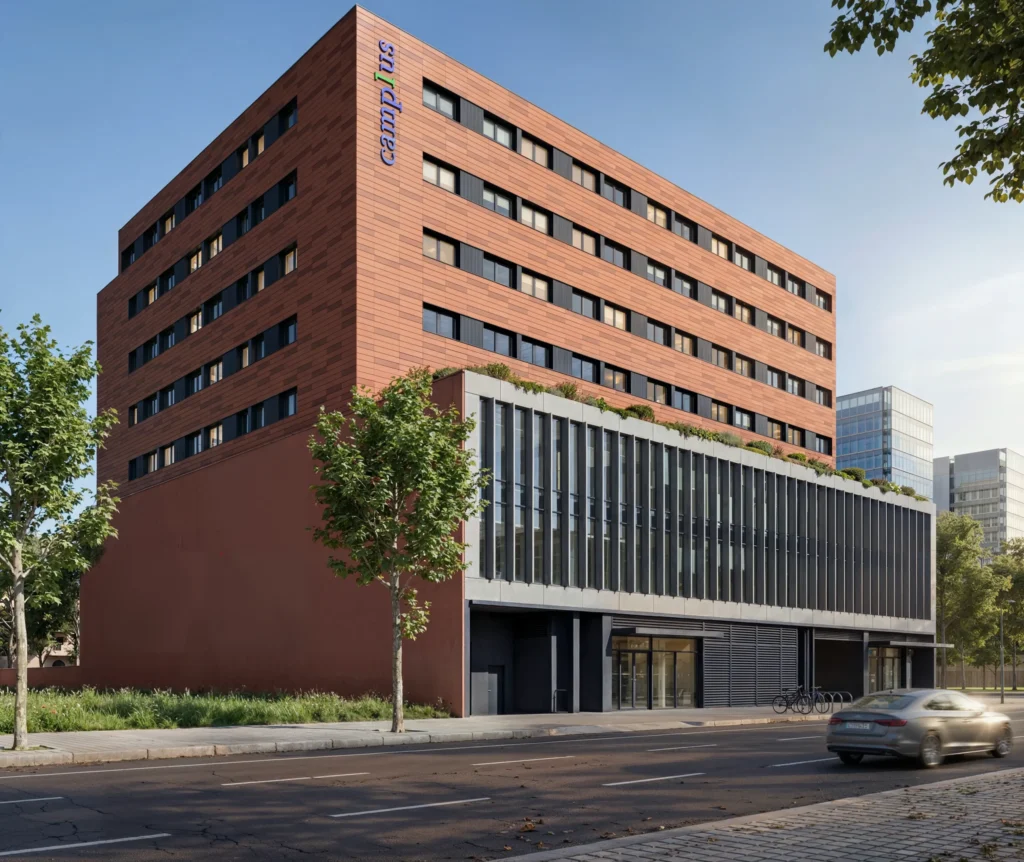
If you are looking for a university residence in Poblenou, Camplus Barcelona Poblenou is an option with 250 places, right in the neighbourhood and very close to the 22@ tech district. A few minutes on foot you will find several city beaches, green areas, the Gran Via, Plaça de les Glòries and the Rambla del Poblenou. According to the Camplus website, it is close to the UB, UPC, UPF and Ramon Llull, with good connections to the centre and the beach.
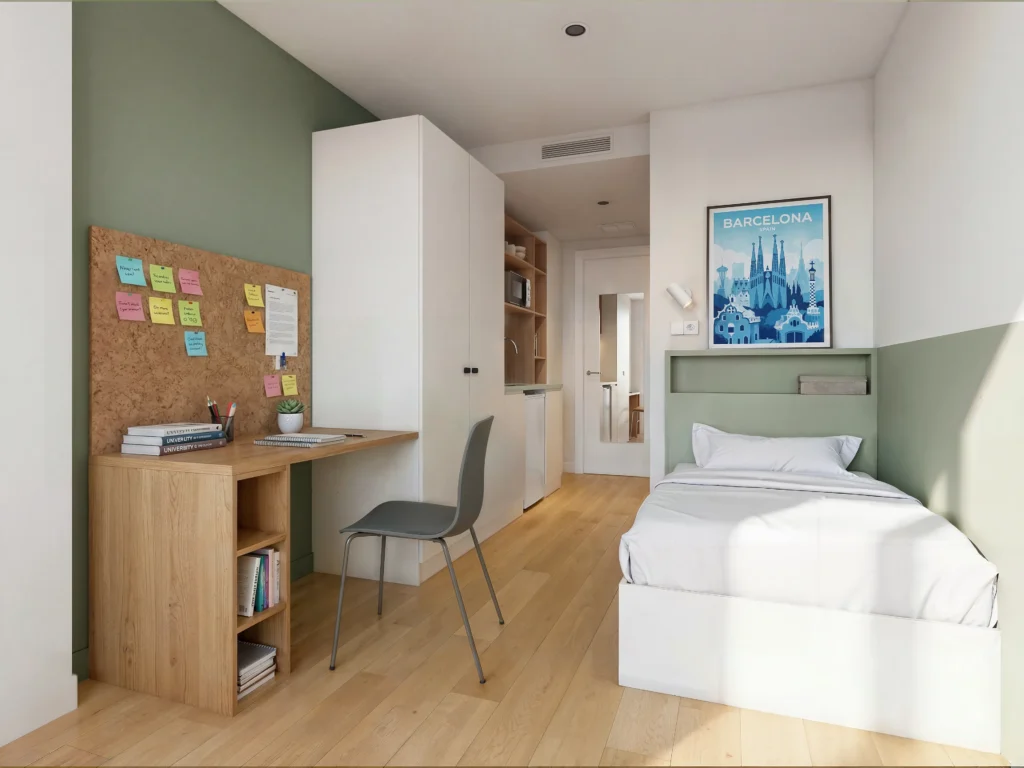
- Rooms with a full private bathroom, with a kitchenette or, in the studios, their own kitchen; plus a fully equipped shared kitchen in the residence.
- There is no meal service: you cook, on your own schedule.
- Free gym (8 am to 10 pm), swimming pool, terraces, study room, teamwork areas, TV room and leisure area.
- Self-service laundry with app, room cleaning every two weeks (with change of bed linen and towels) and daily cleaning of common areas.
- 24-hour reception and staff, CCTV, parking and bicycle parking.
- High-speed WiFi and electricity and water included in the fee.
Camplus is a network with more than 35 years of experience in Spain and Italy, and in the residences of the Camplus network community life is part of the model.
Barcelona arrival checklist
- Confirm your accommodation, your move-in date and the documents you need to provide.
- Check your enrolment, the academic calendar and the language in which each subject is taught.
- Register with T-mobilitat and load your transport pass (the T-Jove, if you are under 30).
- Do the journey to your faculty before the first day, at the time you will have class.
- Request your municipal registration (or your residence’s authorisation to do so) and, if you come from outside the EU, check the TIE deadline.
- Locate a supermarket, a pharmacy and a health centre near your accommodation.
- If you live at Camplus Poblenou, bring coat hangers and an extra towel: they come in handy, especially if you play sport.
- Sign up for activities at your residence and university during the first few weeks: it is the fastest way to meet people.
Frequently asked questions about university life and student residences in Barcelona
Which transport pass suits me if I am under 30?
The T-Jove is usually the most convenient option for daily use: unlimited travel in all zones for 90 days from the first validation, loaded onto a personalised T-mobilitat card. If you will use transport very little, compare it with single tickets or with cycling. Check up-to-date prices and requirements on the TMB website before buying it.
Is it compulsory to register with the council in Barcelona?
According to the City Council, anyone who lives in the city must register, even without regular residence in the country. You can do it at an OAC, by phone or online. If you live in a residence, an authorisation from the property holder is usually required: ask the management and confirm the exact documents by calling 010.
Which area should I live in if I do not yet know which campus I will study at?
Choose an area with good metro and tram connections and check the journey to the usual sites of your university. Barcelona is compact, and Poblenou connects with the centre and the beach. If your campus is outside the city, such as the UAB, prioritise the train connection closest to your accommodation.
Does a student residence include meals?
It depends on the residence. At Camplus Barcelona Poblenou there is no meal service: rooms have a kitchenette or their own kitchen (in the studios) and there is a fully equipped shared kitchen. If you want meals included, always ask before booking which arrangement each accommodation offers and how it works.
Can I apply for a place if the course shows as sold out?
Availability changes depending on the course and the room type. When a room type shows as sold out, the Camplus Poblenou website invites you to write in to see whether your request can be fitted in if vacancies arise. It also accepts temporary stays, although during the academic year full-year stays are given priority.
Organise your arrival and book in good time
Studying in Barcelona is easier when accommodation, transport and paperwork are sorted before the first day. If you want a student residence in Barcelona with services included and in a neighbourhood with a beach, the 22@ district and good connections, discover Camplus Barcelona Poblenou and check availability early: the sooner you ask, the more options you will have for rooms, vacancies and temporary stays.

